Refusing Selective Memory
Its Memorial Day in Israel. I remember my friend David Rosenfeld, Israel’s fallen, and all this conflict's victims of terrorism. And I mean all.

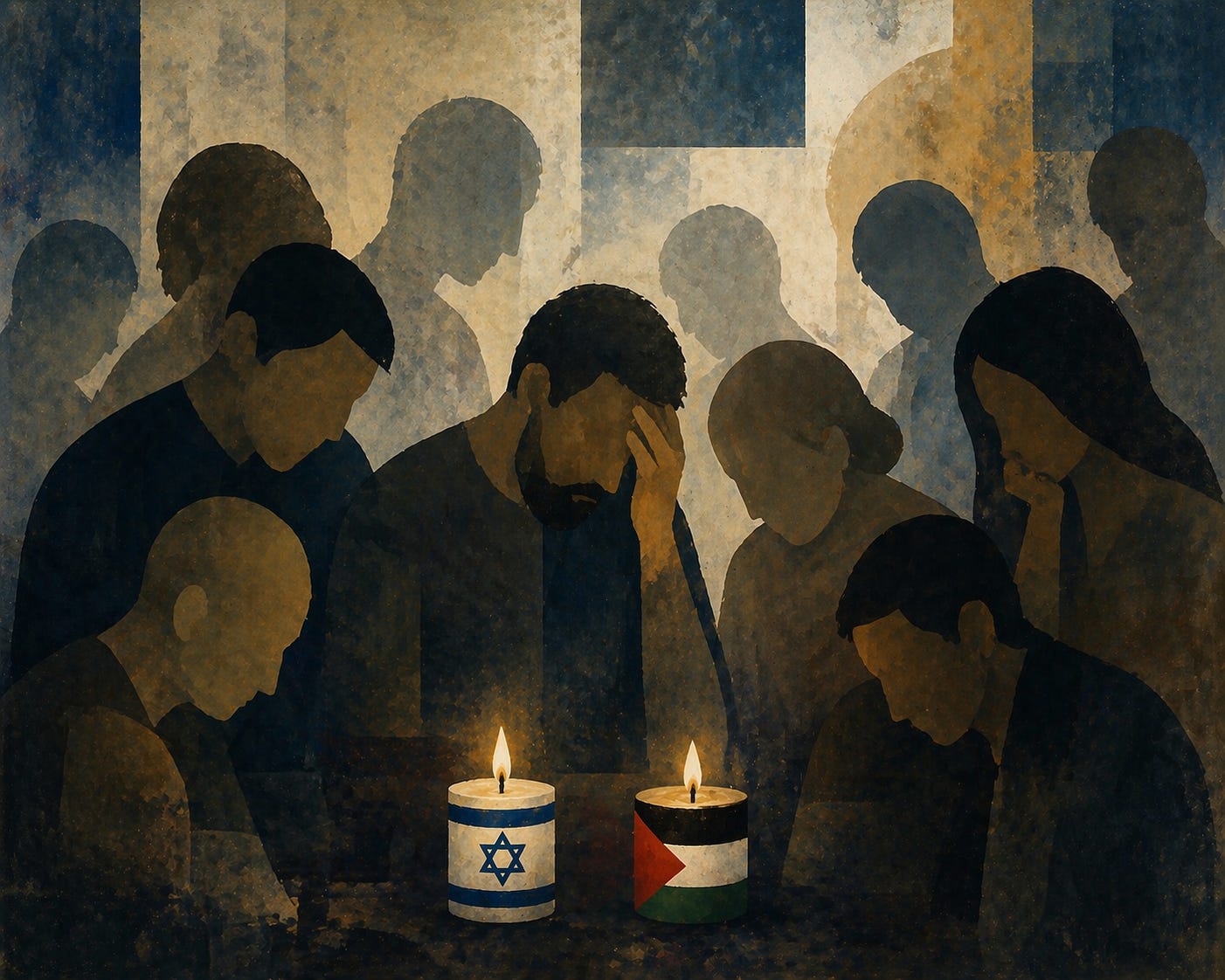
Tonight, as Israel’s Memorial Day (Yom HaZikaron) begins, I am expanding my circle of remembrance. For years, I remembered my friend David Rosenfeld, murdered by Palestinian terrorists in 1982. This year, I remember all victims of terrorism, including innocent Palestinians.
I will certainly remember the Israeli soldiers who fell in battle defending Israel from attack. But I will not remember terrorists, whether Jewish or Palestinian, who set out on a mission to take innocent lives.
And I know what some will say: there are a whole lot more Palestinians who chose terrorism than Jews. Yes, that is true. But so what? I am remembering the innocent, non-terrorist Palestinians killed in this goddamned conflict. And there are a lot of them.
Because if we cannot hold all of their humanity at once, then we have already lost something essential: our humanity.
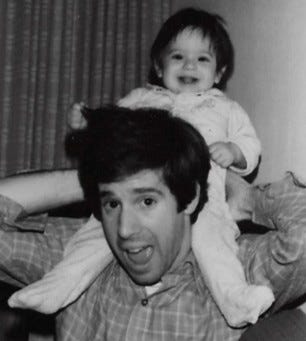
So, I remember David Rosenfeld.
David was a friend. An American from Philadelphia who came to Israel and built a life here. He worked at the bank where I deposited my dollars. We began talking and became fast friends.
In March 1981, as I was preparing to leave Israel after an extended stay, David told me he was moving with his wife and two small children to the West Bank settlement of Tekoa, very near the archaeological site of Herodion. I must have looked at him with unbelieving eyes because he quickly said he was not “one of those” settlers, gun-toting, wild-eyed. David told me what drew him to Tekoa was Rabbi Menachem Froman, who believed Jews and Palestinians might yet meet not only across lines of conflict, but across lines of faith and shared humanity. It was that fragile, improbable hope that took him there, and that he chose to live by. He specifically said he would not carry a weapon. I bid him farewell, we hugged. I never saw him again.
On July 2, 1982, during the Lebanon War, David was alone at Herodion (one of King Herod the Great’s palaces and his tomb) where he was the director of tourism. Two Palestinians attacked him, stabbing him over one hundred times. I learned of his death in an article in the Boston Globe. It was a thunderclap. Something shattered inside me. For years, I carried that loss as a monster-sized chip on my shoulder. I nursed the anger, and in the process, blocked off my soul.
Decades later, it still sits with me.
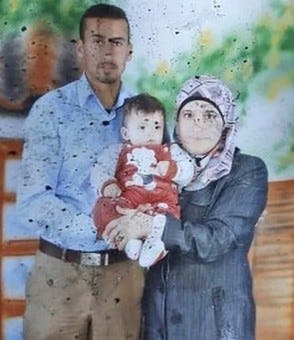
And, this year, I also remember the Dawabsheh family in Duma.
In the early hours of July 31, 2015, Jewish terrorists crept into the village and firebombed the family’s home while they slept. Molotov cocktails were thrown through the windows, engulfing the house in flames within moments. Hebrew graffiti was left on the walls – slogans of revenge, marking the attack as an act of extremist, ideological violence.
Inside that home were a mother, a father, and their two young children. Eighteen-month-old Ali Dawabsheh was burned to death. His parents, Saad and Riham, suffered catastrophic burn injuries and died in the weeks that followed. Their older son, Ahmed, survived, but with severe burns and the trauma of witnessing the destruction of his family. It was not an abstract tragedy. It was intimate, deliberate, and horrifying in its cruelty.
The Jewish terrorist was convicted of murder and sentenced to life imprisonment.
I know Yom HaZikaron is for us Israelis, to remember our losses. I know it is a big ask to extend that grief to Palestinians. I know, because up until now, I also thought that. Felt that.
Yom HaZikaron, I now believe, asks more of us. Maybe even the impossible.
I say this knowing another thing. That in the years after David’s murder, in my own grief I closed my eyes and ears to Palestinian grief. I didn’t want to hear it. I was in my twenties, and I carried this anger into my thirties and forties. That is my confession.
Yet, this anger and hate gave me some insight: we Israelis and Palestinians, in our mutual pain and trauma, fear each other, dehumanize each other, objectify each other, and can’t see beyond our own tribes.
That is indeed a tall order.
Yes, Palestinians in Gaza who were not terrorists, who were caught in a war not of their choosing, should be remembered. Did some or most support Hamas? Yes, but we are not a mob. Israel is a state governed by law. We do not decide who lives or dies based on what we think they might believe.
That is what Hamas does. And I sure as hell don’t want us to be like Hamas.
I firmly believe Hamas bears tremendous responsibility for this state of affairs. It possesses a violent, genocidal and antisemitic ideology that seeks our destruction. Its leadership initiates a major war and then hides while its own civilians remain exposed. It built some 500 kilometers of fortified tunnels and refused to open them to its own people as shelters. Like all totalitarians in history, this is a leadership that treats its own people as expendable.
No. We don’t want to become like that.
So tonight, as the siren sounds, I remember…
David Rosenfeld, my friend.
Ali Dawabsheh. His parents, Saad and Riham. And their older son, Ahmed, who survived, badly burned and alone.
All victims of terror, no matter the perpetrator.
Our soldiers who stood in the breach.
If we cannot hold all of that, if we cannot insist on moral clarity about terrorism while also refusing to surrender our humanity toward innocent life, then we have lost something essential. Our souls.
And yes, many of us have lost that essential something. How else did we get this current government?
This Yom HaZikaron let’s remember our own – and theirs, too. To give all these death a deeper meaning, Yom HaZikaron must also be about who we choose to be in the shadow of our unfathomable losses.
If I may be allowed, Yitzhak, this is a brave and beautiful statement. I hope many others are able to share in this commitment.
Amen